
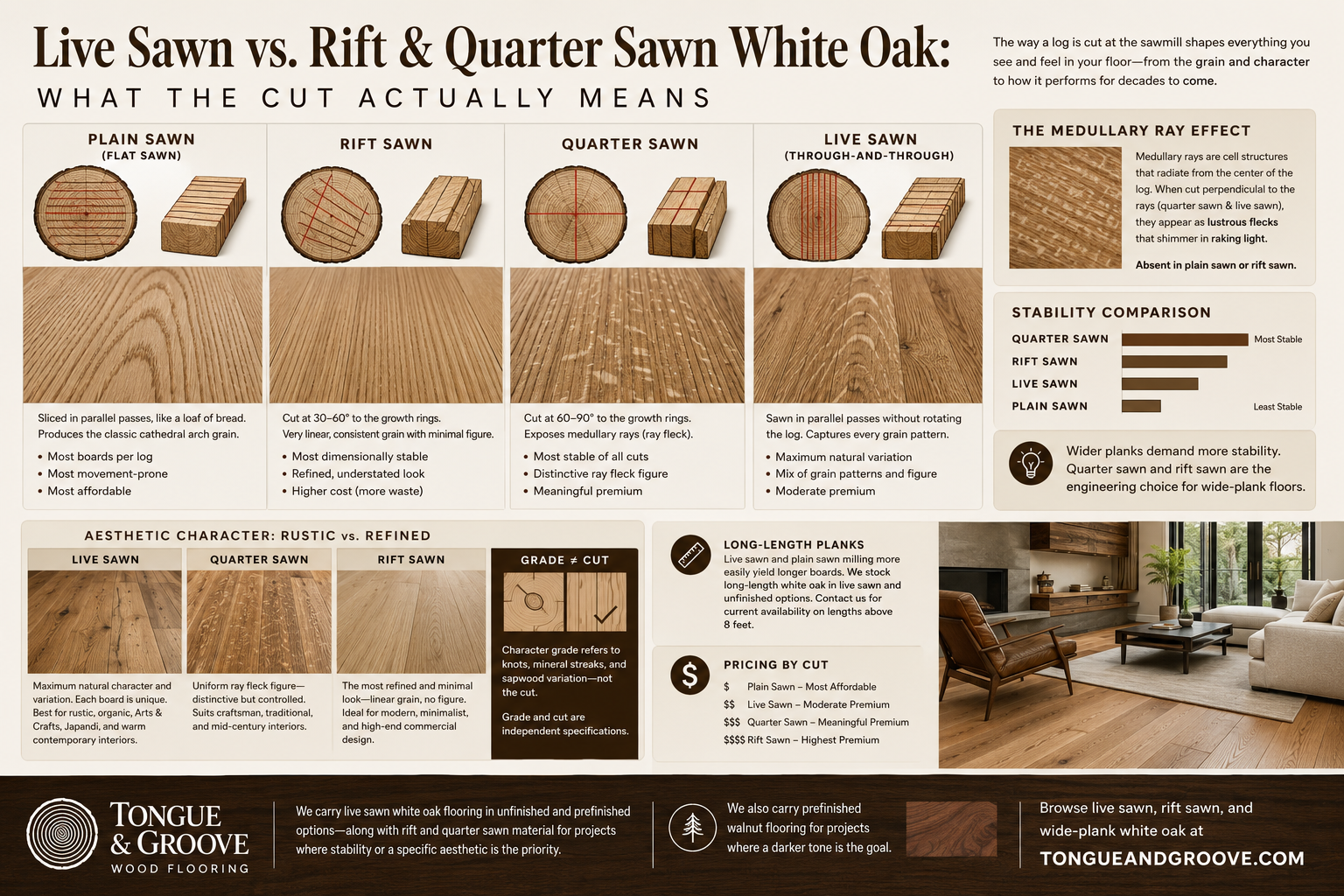
If you've spent any time shopping for white oak flooring, you've run into terms like live sawn, rift sawn, and quarter sawn — and possibly left more confused than when you started. These terms describe how a log is cut into boards at the sawmill, and they have real consequences for the appearance, character, and long-term performance of your floor. This isn't just technical trivia. Understanding the cut helps you know exactly what you're buying and makes the difference between getting a floor that matches your vision and getting something unexpected.
How a Log Gets Cut: The Four Methods
Plain sawn (also called flat sawn):
The most common and economical cutting method. The log is sliced in parallel passes, like slicing a loaf of bread. This produces boards with the characteristic cathedral arch grain pattern on the face. Plain sawn produces the most boards per log but also the most movement-prone boards — the flat grain can cup and move significantly with changes in humidity.
Rift sawn:
Rift sawn boards are cut at roughly 30–60 degrees to the growth rings. This produces boards with a very linear, consistent grain — tight parallel lines with minimal figure. Rift sawn white oak has a refined, understated look that suits contemporary and minimalist interiors. It's also the most dimensionally stable of the four cuts. The trade-off: rift sawing produces more waste per log, which drives up cost.
Quarter sawn:
Quarter sawn boards are cut at 60–90 degrees to the growth rings. This cut exposes the medullary rays of white oak — the distinctive fleck or ray pattern that runs across the grain. Quarter sawn white oak has a unique, almost iridescent quality that no other cut can produce. It's also highly stable — the vertical grain orientation resists cupping and moves far less seasonally than plain sawn.
Live sawn (also called through-and-through or German cut):
Live sawn is the most natural cut. The entire log is sawn in parallel passes from edge to edge, without rotating it — meaning each board captures whatever grain the log presents at that position. Boards from the center of the log will be near-quarter sawn; boards from the outer positions will be near-plain sawn. The result is maximum variation: some boards will have dramatic cathedral grain, others will show the medullary ray figure, and many will show a mix.
Live sawn white oak is the choice for floors where you want the wood to tell its own story — no two boards alike, a rich and organic surface that gets more interesting the longer you look at it.
The Medullary Ray Effect in White Oak
 'White oak is one of the few species where the medullary ray figure is truly spectacular — and it only appears in quarter sawn and live sawn boards where the cut angle exposes it.
Medullary rays are cell structures that radiate outward from the center of the log. When the saw cuts perpendicular to these rays, they appear on the face of the board as lustrous, lighter-toned flecks or streaks. In strong raking light, they catch the light differently from the surrounding grain — the floor almost shimmers.
This figure is completely absent in plain sawn or rift sawn boards. If the ray figure is part of why you love the look of white oak, you want quarter sawn or live sawn material.
'White oak is one of the few species where the medullary ray figure is truly spectacular — and it only appears in quarter sawn and live sawn boards where the cut angle exposes it.Stability Differences
This is where practical performance diverges:
Quarter sawn: most stable; vertical grain resists cupping; ideal for wide planks and humid climates
Rift sawn: nearly as stable as quarter sawn; the best choice for very uniform wide-plank floors
Live sawn: intermediate stability; some boards (the near-quarter-sawn ones) are highly stable, others (near-plain-sawn) will move more
Plain sawn: least stable; boards are prone to cupping, particularly in wide widths
For wide-plank floors — especially long length white oak flooring in 5" widths and above — stability is a meaningful selection criterion. Quarter sawn and rift sawn are the engineering choice for wide-plank applications. Live sawn is acceptable with proper installation (correct subfloor moisture, full-spread adhesive for wide planks, proper acclimation).
Quarter sawn: most stable; vertical grain resists cupping; ideal for wide planks and humid climates
Rift sawn: nearly as stable as quarter sawn; the best choice for very uniform wide-plank floors
Live sawn: intermediate stability; some boards (the near-quarter-sawn ones) are highly stable, others (near-plain-sawn) will move more
Plain sawn: least stable; boards are prone to cupping, particularly in wide widths
Aesthetic Character: Rustic vs. Refined
The cut and the aesthetic are deeply connected:
Live sawn:
Maximum natural character and variation
Mix of grain patterns gives a floor a lived-in, artisanal quality
Best for rustic, organic, Arts & Crafts, Japandi, and warm contemporary interiors
Each board is unique — the floor has a handmade quality
Quarter sawn:
Uniform ray fleck figure — distinctive but controlled
The right choice when you want character without randomness
Suits craftsman, traditional, and mid-century interiors
Rift sawn:
The most refined and minimal look — linear grain, no figure
Often used in high-end commercial design and modernist residential projects
Pairs well with concrete, steel, and minimal architecture
A common misconception: 'character grade' refers to knots, mineral streaks, and sapwood variation — not the cut. You can have a live sawn floor in select grade (minimal character) or a rift sawn floor in character grade (significant variation). Grade and cut are independent specifications.
Maximum natural character and variation
Mix of grain patterns gives a floor a lived-in, artisanal quality
Best for rustic, organic, Arts & Crafts, Japandi, and warm contemporary interiors
Each board is unique — the floor has a handmade quality
Uniform ray fleck figure — distinctive but controlled
The right choice when you want character without randomness
Suits craftsman, traditional, and mid-century interiors
The most refined and minimal look — linear grain, no figure
Often used in high-end commercial design and modernist residential projects
Pairs well with concrete, steel, and minimal architecture
Long-Length Planks: What's Available
One of the most common requests we hear is for long-length white oak flooring — planks that minimize the number of end joints across a room, creating a cleaner, more expansive look.
Long-length availability is directly tied to log quality and size. Live sawn and plain sawn milling can more easily yield longer boards because the cut goes straight through the log. Rift and quarter sawn milling, which requires more precise log rotation, can produce long boards but at higher yield loss.
At Tongue & Groove, we stock long-length white oak flooring in live sawn and unfinished options. Plank lengths vary by batch and availability — contact us for current stock on lengths above 8 feet, which require advance planning for larger projects.
Pricing Differences Between Cuts
As a general reference:
Plain sawn: most affordable — highest yield per log
Live sawn: moderate premium — requires larger-diameter logs, no log rotation
Quarter sawn: meaningful premium — log must be quartered and re-oriented repeatedly
Rift sawn: highest premium — most waste-intensive cut, fewest boards per log
For unfinished white oak hardwood flooring, the total project cost difference between plain and rift sawn can be significant on a per-square-foot basis, particularly for large projects. It's worth understanding what visual and performance outcome you're paying for before you spec.
Plain sawn: most affordable — highest yield per log
Live sawn: moderate premium — requires larger-diameter logs, no log rotation
Quarter sawn: meaningful premium — log must be quartered and re-oriented repeatedly
Rift sawn: highest premium — most waste-intensive cut, fewest boards per log

