
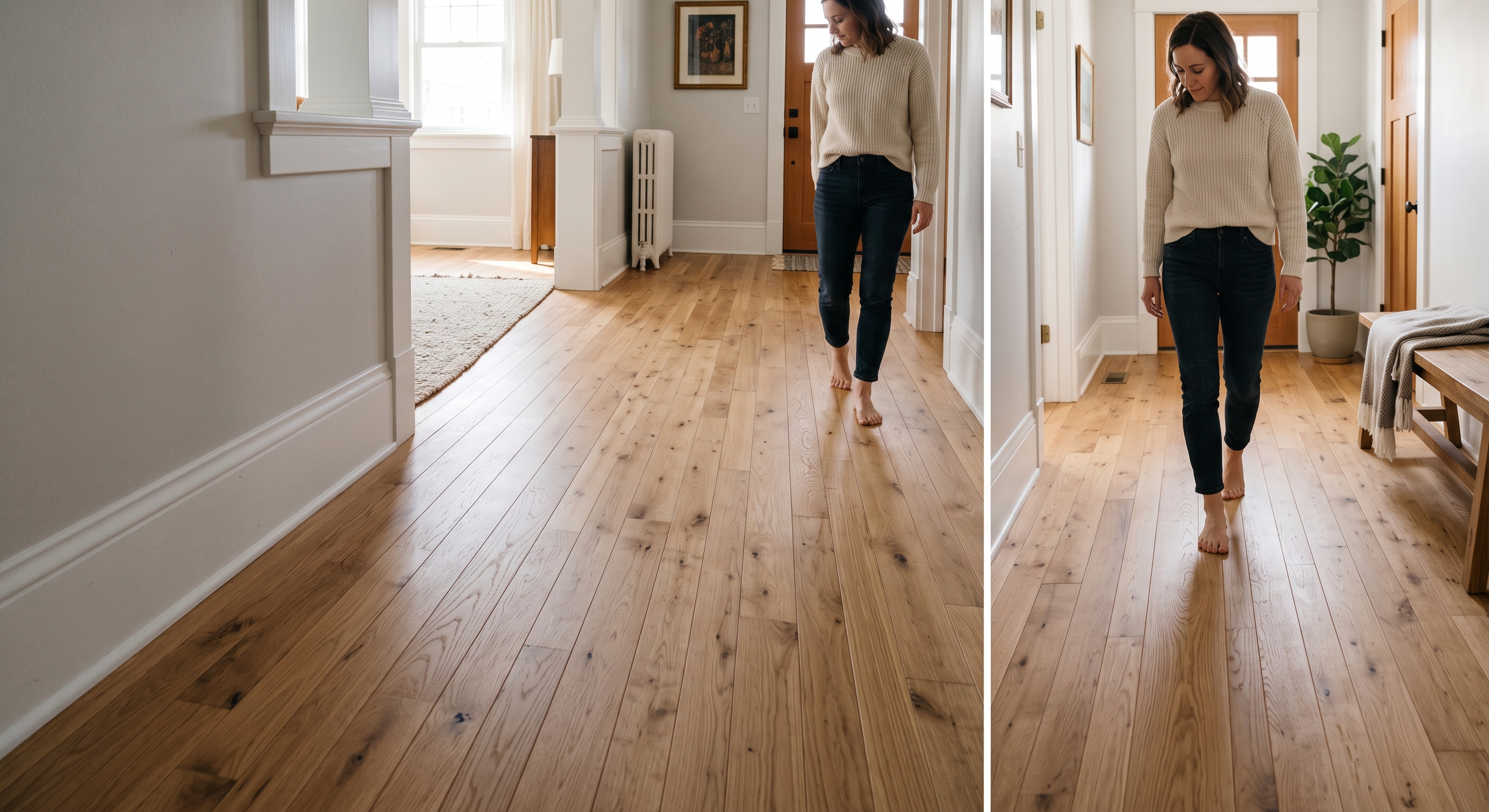
When most people picture hardwood floors, they picture wide planks, 4", 5", or wider boards that show off grain and make a room feel expansive. But a significant share of buyers searching for hardwood flooring are looking for something different: narrow, thinner-profile boards that serve specific installation purposes, match existing floors, or work in spaces where standard-width planks simply won't do.
If you've been searching for 1.5" hardwood flooring, 2" oak planks, or thin hardwood flooring options and keep running into generic wide-plank results, this guide is for you. Here's what these products are, why they exist, and how to choose the right spec for your project.
Why Narrow and Thin Planks Exist
Narrow hardwood flooring, typically 1.5" to 2.25" face width, was the standard in American homes through most of the 20th century. Strip flooring in 1.5" and 2.25" widths is what filled the hallways, bedrooms, and living rooms of homes built from the 1920s through the 1970s. If you live in an older home, there's a good chance this is exactly what's already under your feet in adjacent rooms.
Thin hardwood flooring, typically 3/8" or 1/2" thick rather than the standard 3/4", serves a different purpose: it allows hardwood to be installed over existing floors without raising the height significantly, bridges height transitions at thresholds, and is used in top-nail applications where thinner stock is required.
The two dimensions are often combined. A 3/8" x 1.5" red oak board, for instance, is both narrow and thin, a profile used in top-nail installations in historic homes and renovation work where the subfloor configuration demands it.
The most common reason buyers search for narrow or thin hardwood: they're trying to match existing floors in an older home. Getting the width and profile right is the only way to achieve a seamless blend.
Understanding the Key Dimensions
Face width (how wide the board looks on the floor):
1" wide: very narrow, typically used for inlay borders and accent work
1.5" wide: the classic strip floor width; matches most pre-1970s American hardwood floors
2" wide: slightly more contemporary than 1.5"; still narrow by modern standards
2.25" wide: the most common historic strip floor width, widely available in red oak
3" and above: where modern flooring convention begins
Thickness (how deep the board is):
3/4" thick: standard solid hardwood; nail-down over plywood subfloor
1/2" thick: engineered hardwood; floating, glue-down, or nail-down
5/16" thick: top-nail profile; designed for specific installation methods in renovation work
3/8" thick: thin solid hardwood; used for top-nail applications and height-transition situations
When a listing says "3/8 x 1.5" or "5/16 x 1.75", it's giving you thickness first, face width second. Both dimensions matter.
Top-Nail Oak Flooring: What It Is and When You Need It
Top-nail oak flooring is a specific profile, typically 5/16" thick, designed to be face-nailed through the top of the board rather than blind-nailed through the tongue. This method is used in situations where the subfloor configuration prevents standard installation:
Installing over a concrete slab where nail-down isn't possible, and glue-down isn't preferred
Stair treads and landings where the board needs to be secured from the face
Renovation work over existing subfloors that aren't thick enough for blind nailing
Repairs to existing top-nail floors where matching the installation method is necessary
The face nail is set below the surface with a nail punch and filled with a matching wood filler after installation. In a properly finished floor, the filled nail holes are nearly invisible, a technique that's been used in hardwood installation for over a century.
Tongue & Groove stocks top-nail oak flooring in both red oak and white oak, in 5/16" thickness profiles. These are the products most commonly used for renovation matching and for stair-landing installations.
If you're repairing or extending a floor that was originally installed with top nails, matching that installation method matters as much as matching the species and width. Using standard blind-nail stock in a top-nail floor will look and feel different.
Red Oak vs. White Oak in Narrow Profiles
Both species are available in narrow widths, but there's a practical reason why red oak dominates the thin/narrow category historically:
Red oak was the standard species used in American strip flooring through most of the 20th century
If you're matching existing floors in a home built before 1990, red oak in 1.5"–2.25" widths is almost certainly what you need
White oak in narrow profiles is available and popular for new installations that want a contemporary look with a historic form factor
White oak takes stain more evenly and has a tighter grain, better for installations where the finish is a primary design consideration
Species mismatch is one of the most common mistakes in floor repair and extension work. If the existing floor is red oak with a warm amber tone, installing white oak, even with a similar stain, will be visible in raking light due to the difference in grain structure. When in doubt, bring a sample of the existing floor and compare.
Height Transition Considerations
One of the most practical reasons to choose thin hardwood is managing transitions between floor heights. When installing hardwood in a room that connects to existing tile, carpet, or a different hardwood at a different height, the new floor's thickness directly affects how the transition is managed.
Standard 3/4" hardwood raises the finished floor height by approximately 3/4" plus the subfloor system
3/8" hardwood cuts that addition roughly in half, making threshold transitions less abrupt
5/16" top-nail profiles are the thinnest solid hardwood option for installations where height is tightly constrained
In kitchen renovations that connect to existing hardwood in a dining room, or in historic homes where adding floor height affects door clearances, this is a meaningful specification decision, not just an aesthetic one.
Matching Existing Floors: A Practical Process
If matching is the goal, here's the sequence that works:
Measure the existing floorboards carefully: face width (not including the tongue), thickness if you can access a transition or remove a vent cover, and species if identifiable
Note the grain pattern: red oak has a more open, pronounced grain; white oak is tighter and more uniform
Assess the finish: oil-based polyurethane (warm amber), water-based (clearer), or oil finish (matte, penetrating). This affects how new boards will look even with the same stain
Order an unfinished board in the matching spec and sand/finish it alongside a sample of the existing floor before committing to the full order
If you're extending rather than repairing, consider refinishing the entire connected floor after installation so the new and old sections start with the same fresh finish
Tongue & Groove Narrow Flooring Options
We stock narrow and thin hardwood flooring in red oak and white oak, across a range of widths from 1" to 2.25" and thickness profiles from 5/16" to 3/4". Our inventory includes:
3/8" x 1.5" Select & Better Red Oak, one of our most-requested products for historic floor matching
5/16" x 1.75" and 5/16" x 2" top-nail profiles in red oak and white oak
3/4" x 1.5" and 3/4" x 2.25" standard strip flooring in select grades
Unfinished stock in all widths for on-site staining and finishing
If you're not sure which spec matches your existing floor, we're happy to help you work through it. Send us photos and dimensions of your existing floor, and we'll point you toward the right product before you order.
Browse narrow and thin hardwood flooring at tongueandgroove.com

