
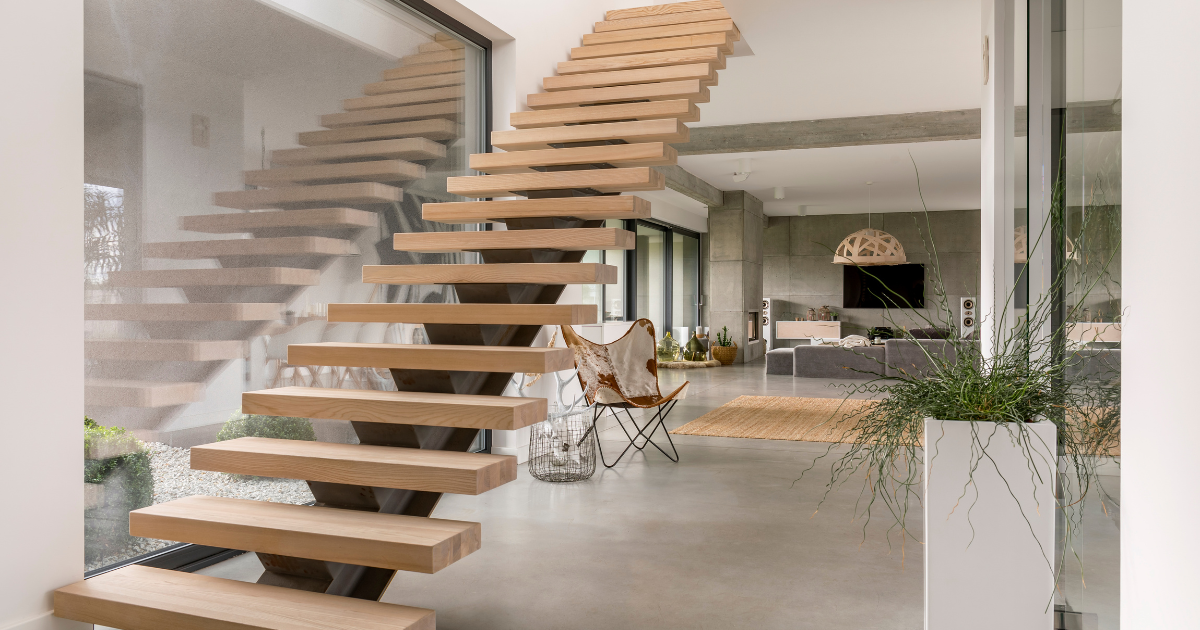
Floating staircases are one of the most visually striking architectural features in contemporary residential design. Where a traditional staircase has a closed structure- stringers, risers, a soffit underneath- a floating stair appears to emerge from the wall with nothing supporting it from below. Each tread seems to hover in space, which creates an open, light-filled quality that conventional stair construction can't replicate.
The treads themselves are what make or break this look. Because they're exposed on all sides- top, bottom, front edge, and both ends- floating stair treads have to be engineered and finished differently than standard stair treads. If you're planning a floating staircase, here's what you need to know about the wood, the specs, and what to ask for.
What Makes a Floating Staircase 'Float'
The floating effect comes from how the treads are attached. Rather than resting on top of a stringer (the diagonal support on each side of a traditional staircase), floating stair treads are cantilevered from a structural steel channel or spine concealed inside the wall. The wall carries the load; the tread projects out from it with no visible support below.
This means each tread is effectively a cantilever beam; it has to be stiff enough not to flex noticeably under load, particularly at the free end. That's why floating stair treads are almost always thicker than conventional treads, and why material selection and grain orientation matter structurally, not just aesthetically.
In a floating staircase, the tread is the structure. You're looking at it from four sides simultaneously: top surface, front face, underside, and ends. The wood has to be beautiful from every angle and engineered to carry the load without flexing.
How Floating Treads Differ from Standard Stair Treads
Several specifications change when you move from a conventional closed staircase to a floating design:
Thickness: Standard residential stair treads are often 1" to 1.5" thick. Floating treads are typically 2" to 3", sometimes thicker for longer cantilever spans. The added mass provides rigidity and eliminates the springy, flexible feeling that undermines the look of an otherwise beautiful staircase. It also gives the tread enough depth to accept the hidden mounting hardware without compromising structural integrity.
All-sides finish: A standard tread only needs to be finished on the top surface and nosing; the underside and ends are enclosed by risers and stringers. Floating treads need to be finished on all four exposed faces. This means selecting wood with clean, consistent character throughout the board (not just on the face), and using a finish that looks intentional from below.
End grain treatment: The ends of floating treads are visible where they meet the wall (on one or both sides depending on the design). End grain absorbs finish differently than face grain; it will look darker and more prominent unless it's specifically prepared. Many installations use an end-grain cap or a return miter to present face grain at the ends as well.
Hardware integration: The tread has to accept the mounting bracket or threaded rod system that connects it to the structural spine. These connections are typically routed into the back face of the tread and need to be precisely located, usually done by the installer after the structural system is in place. Your tread stock needs to be thick enough to accommodate this without the hardware coming through the top surface.
Thickness Specifications for Floating Treads
2" thick: The standard starting point for floating treads in spans up to about 42" (the standard residential staircase width). Two-inch treads have enough rigidity for most residential applications and give installers adequate depth for hardware integration. This is the right specification for most single-family home floating staircases.
2.5" to 3" thick: Used for wider spans (42"–60"+), for treads with longer cantilever distances, or when the design calls for a particularly substantial, furniture-like presence. Three-inch oak treads have a visual weight that reads as truly architectural, especially when the grain and finish are executed well. These are also specified in commercial floating stair applications where building codes require higher load ratings.
Custom thickness: Some architects and designers spec non-standard thicknesses (1.75", 2.25", 3.5") for specific structural or aesthetic reasons. Custom millwork is available for projects where the standard range doesn't fit the design.
For the hardware side: work with your structural engineer or stair fabricator to confirm the required tread thickness before ordering material. The mounting system determines the minimum usable depth.
Don't order tread stock before the structural system is confirmed. The bracket type and mounting depth dictate your minimum thickness, and changing the spec after the fact wastes expensive material.
Wood Species for Floating Treads
White oak (most recommended)
White oak is the species of choice for floating staircases in contemporary design. Its tight, consistent grain reads well from all four exposed faces, particularly the end grain, which has a clean, almost geometric quality in white oak. It's hard enough (Janka 1360) for heavy residential traffic and takes both oil and film finishes extremely well. Live sawn and rift sawn white oak are both popular in floating stair applications, each offering a different grain character:
Rift sawn white oak: the most refined option, tight, linear grain with minimal variation, no medullary ray figure; suits minimalist and high-design staircases
Live sawn white oak: more natural variation; some boards will show the distinctive ray fleck; suits warmer, more organic interiors
Quarter sawn white oak: consistent ray fleck figure across all boards; the most distinctive look and the most dimensionally stable for wide treads
→ Related: Live Sawn vs. Rift & Quarter Sawn White Oak: What the Cut Actually Means
Walnut
Walnut's rich, dark tones make a dramatic statement in floating stair applications, particularly against light walls and open interiors where the dark treads stand in strong contrast. Walnut is softer than white oak (Janka 1010), appropriate for residential use but worth noting if the household is hard on floors. The flowing, sometimes figured grain of walnut looks particularly good in floating treads where all four faces are visible.
Hickory
For rustic or lodge-inspired interiors, hickory's high hardness (Janka 1820) and dramatic natural variation make it a strong floating tread choice. The sharp contrast between sapwood and heartwood in hickory can be a feature rather than a defect in this application — each tread becomes its own visual moment.
Species to approach with caution
Softer species (pine, cherry below 900 Janka) will dent and wear in stair applications — avoid for floating treads regardless of aesthetic appeal
Heavily figured or unstable species can move seasonally in wide floating treads — stability matters more here than in floor applications
Prefinished vs. Site-Finished Floating Treads
This decision deserves more thought in floating stair applications than in conventional flooring.
Site-finished treads give you complete control over the final appearance and allow the finish to be matched precisely to adjacent flooring. The challenge is that floating treads need to be finished on all faces, including the underside and ends, which is easier to do before installation than after. Many installers do a preliminary finish on all faces before mounting, then touch up the top surface after installation.
Prefinished treads offer a factory-grade finish that's extremely durable and arrives ready to mount. The trade-off is less flexibility on color and sheen, and the challenge of matching adjacent floors if they're site-finished. For projects where the stair floats in a space without adjacent hardwood, or where the stair is deliberately designed as a contrast element, prefinished is a strong option.
One important note on finish for floating treads: the underside of the tread should be finished even if it won't be touched; unsealed wood on the bottom surface will absorb ambient moisture unevenly, which can cause cupping or warping in the tread over time. Seal all faces.
Open Riser vs. Closed Riser Floating Staircases
Most floating staircases are open riser; there's no vertical board between treads, so you can see through the staircase. This is part of the floating aesthetic and is standard in contemporary architectural floating stair design.
Some floating designs incorporate glass panel risers, which provide visual transparency while adding a safety barrier, preferred in homes with young children or in commercial applications where building codes require enclosed risers.
Closed-riser floating stairs exist but somewhat contradict the design logic; if risers are present, much of the floating effect is lost. Discuss riser treatment with your designer or architect before committing to a tread specification.
Building Code Considerations
Floating staircases are subject to the same residential code requirements as conventional stairs, plus additional structural requirements. Key points:
Tread depth minimum: 10" (IRC standard)
Riser height maximum: 7.75", with uniformity within 3/8" across all risers
Load rating: residential stairs must support a 300 lbs concentrated load per tread; confirm your structural system and tread thickness meet this
Handrails: required on any stair with 4 or more risers, 34"–38" above tread nosing
Guards: if the open side of the stair is more than 30" above grade, a guard system is required
Floating staircases in particular should have structural drawings stamped by a licensed engineer before installation begins. The cantilevered load path is more complex than a conventional stair and needs to be verified for your specific span and tread weight.
Tongue & Groove Floating Stair Tread Options
We supply floating stair treads in white oak, red oak, and hickory, in 2", 2.5", and 3" thicknesses, with retro, square-edge, and custom nosing profiles. Both prefinished and unfinished material is available, and we can source long-length single-board treads for wide staircases where a single piece per tread is preferred over a glued-up panel.
Our team has supplied treads for floating staircase projects across a range of architectural styles, from minimalist urban condos to warm, organic residential renovations. If you have drawings or specifications from your fabricator or designer, we're happy to work from those directly.
Shop floating stair treads in white oak, red oak, and hickory at tongueandgroove.com

