
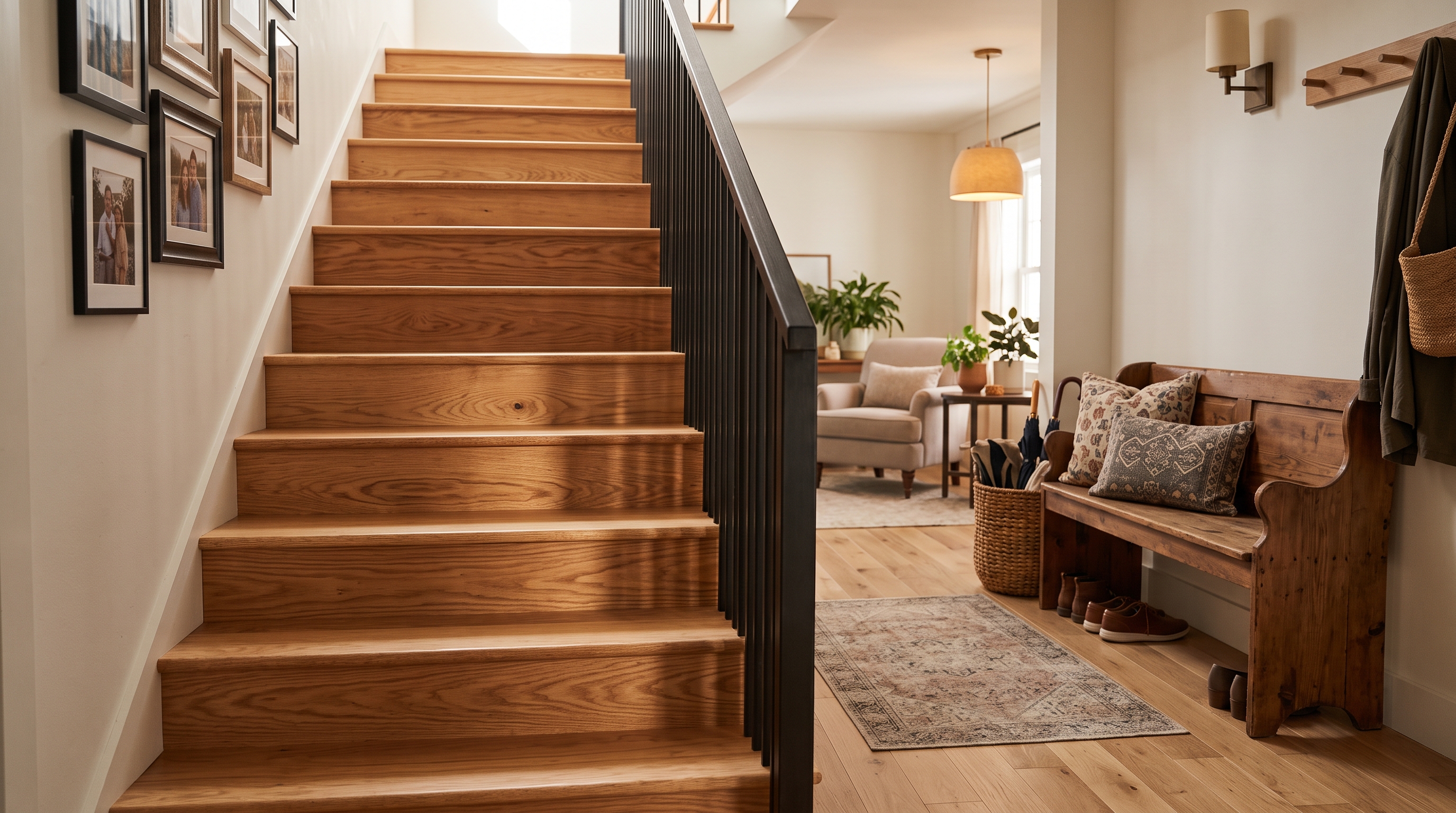
A staircase is one of the most used and most noticed features in any home. Every person who enters walks it. It gets touched, looked at, and evaluated constantly -- by family, by guests, and eventually by buyers if you ever sell. Getting the stair treads right matters more than almost any other finish decision in the house.
Wood stair treads are the single most impactful upgrade to any staircase -- more so than balusters, newel posts, or paint color. The right tread species and finish ties a home together and signals the quality of the whole renovation. The wrong choice -- or a cheap substitute -- shows immediately and ages badly.
This guide covers everything you need to choose and buy wood stair treads confidently: species, thickness, profiles, matching your floors, and the difference between a standard tread and a floating tread for open-riser staircases.
Why Wood Is the Right Material for Stair Treads
Stair treads take the most concentrated foot traffic in any home -- more than hallways, more than entryways, more than kitchens. Every step lands in roughly the same spot: the front third of the tread, right behind the nosing. This wear pattern is relentless and completely predictable.
Hardwood handles this better than any other material. Carpet wears and stains. Laminate chips and delaminates at high-stress edges. Engineered composites scratch permanently. Hardwood wears gradually, shows patina gracefully, and -- critically -- can be sanded and refinished when the wear becomes noticeable. A quality set of hardwood stair treads installed today will outlast every other material option and look better at year 20 than carpet looks at year 5.
The key word is hardwood. Not all wood is created equal for stair use. Species selection -- specifically hardness -- matters more on stairs than it does on floors.
The front edge of every stair tread -- the nosing -- takes the full impact of every step. This is where cheap treads fail first. A properly specified hardwood tread in white oak, red oak, or hickory will survive decades of daily use without structural degradation.
Species Guide: Choosing the Right Wood
White Oak -- the contemporary standard
White oak has become the dominant choice for stair treads in new construction and renovation over the past decade, and the reasons are straightforward. Its Janka hardness of 1,360 lbf is well above the minimum for stair use. Its grain -- tight, consistent, with the distinctive medullary ray figure visible in rift and quarter sawn cuts -- reads as both timeless and contemporary. And its color, a warm neutral ranging from pale tan to golden brown, works with virtually any interior palette.
Janka hardness: 1,360 lbf -- excellent stair durability
Color: light tan to warm golden brown, neutral undertone
Grain: tight and consistent; ray fleck visible in rift/quarter sawn
Best for: contemporary, transitional, Scandinavian, and traditional interiors
Finish: takes both oil and film finishes exceptionally well; clear-finished white oak is the most popular stair tread look today
→ Related: Live Sawn vs. Rift & Quarter Sawn White Oak: What the Cut Actually Means
Red Oak -- the classic American choice
Red oak has been the standard American stair tread material for most of the 20th century. Its warm, pinkish-brown color and open, pronounced grain give it a familiar, traditional quality that suits craftsman, colonial, and farmhouse interiors naturally. At 1,290 Janka, it's slightly softer than white oak but entirely appropriate for residential stair use.
Janka hardness: 1,290 lbf -- proven for residential stair traffic
Color: warm pinkish-tan to medium reddish-brown
Grain: open and pronounced -- more textural and rustic than white oak
Best for: traditional, craftsman, colonial, and farmhouse interiors
Key advantage: if your existing floors are red oak (likely in any pre-1990 home), red oak treads allow seamless species matching throughout the home
→ Related: Red Oak Flooring: Species Guide, Grades & Why It's Still America's Hardwood
Hickory -- the hardest domestic option
Hickory is the hardest domestic hardwood commonly available for stair treads, with a Janka rating of 1,820 lbf -- 40% harder than red oak. It's also the most dramatically figured species, with sharp contrast between creamy sapwood and dark heartwood that creates bold, individual character in each tread. Hickory treads are specified for high-traffic commercial-style applications, homes with heavy use, and interiors where a rustic or lodge aesthetic is intentional.
Janka hardness: 1,820 lbf -- hardest domestic option
Color: cream to dark brown, often sharply contrasted within a single board
Grain: wild and flowing, high natural variation
Best for: rustic, lodge, farmhouse, and high-traffic applications
Note: the color variation in hickory is dramatic -- order samples before committing to see what you're working with
As a general rule for species selection: match your stair treads to your main floor species for visual continuity through the home. The staircase connects floors -- a tread that fights the flooring creates a visual interruption that no amount of styling will fix.
Tread Thickness: What the Numbers Mean
Thickness is the specification buyers most often get wrong -- either under-specifying for a renovation application or over-specifying unnecessarily for a simple replacement. Here's the complete breakdown:
Standard thickness (3/4 inch to 1 inch):
Appropriate for new construction where the tread is fully supported by a closed stringer on each side. Standard-thickness treads are lighter, less expensive, and structurally adequate when properly supported. They are not appropriate for floating stair applications or for installation over existing treads without additional blocking.
Thick treads (1.5 inch to 2 inch):
The most commonly specified thickness for renovation work. Thick treads can be installed directly over existing treads without demolition -- the old tread becomes the substrate. They're also the minimum recommended thickness for treads with an overhanging nosing and for any tread where the underside is partially visible. Visually, thick treads have a substantial presence that standard treads lack. This is the right specification for most residential renovation projects.
Extra-thick treads (2.5 inch to 3 inch):
Specified for floating stair designs, architectural open-riser staircases, and applications where the tread itself is a structural and design element. At 3 inches of thickness, a white oak tread has the visual weight of a timber -- commanding and unmistakably intentional. Also the minimum for most floating stair hardware systems, which require sufficient depth to accommodate the internal mounting bracket without compromising the top surface.
→ Related: Floating Stair Treads: Everything You Need to Know Before You Buy
Nosing Profiles: The Front Edge Decision
The nosing is the front edge of the tread -- the part that overhangs the riser and takes the most direct impact. Profile selection affects both the safety and the visual character of the staircase.
Square edge / eased edge:
Clean and modern. The front edge is cut square with a slightly softened corner. This is the contemporary standard -- works with open-riser floating staircases and any interior where a crisp, architectural look is the goal. Requires careful installation to ensure the corner isn't sharp enough to be a hazard.
Bullnose / rounded nosing:
The traditional profile with a fully rounded front edge. The most forgiving underfoot and the most classical in appearance. Standard for traditional closed-riser staircases and for treads used in craftsman and colonial interiors.
Retro tread profile:
A distinctive profile where the nosing has a return on its underside -- the tread edge wraps around to present face grain on the bottom as well as the top. Used when the underside of the staircase is visible (open balusters, glass panels, or open-riser construction), giving the tread a finished, furniture-like appearance from all angles. A detail that signals quality in a floating or open staircase design.
Matching Treads to Your Floors
This is the most common practical question in stair tread purchasing, and it deserves a careful answer because it's where the most mistakes happen.
Step 1: Identify the species.
Red oak and white oak are the two most likely species in any American home. The easiest visual cue is color temperature: red oak has a warm, pinkish-brown undertone; white oak reads cooler, more neutral -- taupe to golden brown. In raking light, white oak in rift or quarter sawn cuts will show the distinctive ray fleck (a lustrous, lighter-toned figure running across the grain); red oak does not.
Step 2: Identify the width.
Measure the face width of the existing floorboards (not including any tongue). Historic strip floors are almost always 1.5 inches or 2.25 inches wide. Contemporary plank floors are typically 3 inches to 5 inches wide. If the stair treads will be visible adjacent to the main floor, matching the width creates visual continuity.
Step 3: Match the finish type, not just the stain color.
This is the step most people miss. A water-based polyurethane finish will look noticeably cooler and lighter than an oil-based finish even with identical stain. If the existing floors have an oil-based poly (likely in any pre-2000 home), matching with water-based will create a visible mismatch. Order unfinished treads and finish them on-site with the same product as your floors, or have your installer match the finish system precisely.
Step 4: Order samples first.
A 4-inch sample square looks different on a paper spec sheet than it does sitting on your actual stair landing under your actual light. Always order samples before committing to a full tread purchase, especially when matching is the goal.
Prefinished vs. Unfinished Wood Stair Treads
Prefinished treads:
Factory-applied finish arrives ready to install -- no sanding, no staining, no dry time. The aluminum oxide or UV-cured coating on prefinished treads is among the most durable finishes available, typically rated for heavy commercial use. Prefinished is the right choice when installation speed matters, when the household can't be disrupted by finishing fumes, or when the treads are a standalone replacement rather than a matching project.
Unfinished treads:
Raw wood that's sanded and finished on-site after installation. Gives complete control over stain color and finish system -- the only way to achieve a precise match to existing floors. Requires more time and planning: the staircase needs to be vacated during sanding and finishing, and finish coats need dry time between applications.
For most matching projects, unfinished is the right call. For standalone tread replacements or new staircases without an adjacent floor to match, prefinished simplifies the project significantly.
Building Code Basics
Stair treads in residential construction are governed by the International Residential Code (IRC) and local amendments. The key minimums:
Tread depth (front-to-back, not including the nosing): minimum 10 inches
Nosing projection: 3/4 inch to 1-1/4 inch overhang beyond the riser face
Riser height: maximum 7-3/4 inches; all risers in a stair run must be within 3/8 inch of each other
Stair width: minimum 36 inches clear
Uniformity: the most important and most violated requirement -- every tread must be the same depth and every riser the same height within the tolerance, or a tripping hazard exists
Always verify with local code requirements before finalizing specifications. Some jurisdictions have additional requirements beyond IRC minimums, particularly for commercial or multi-family applications.
Tongue & Groove Wood Stair Treads
We supply wood stair treads in white oak, red oak, and hickory -- in standard, thick (1.5 inch and 2 inch), and extra-thick (2.5 inch and 3 inch) profiles, with retro, bullnose, and square-edge nosing options. Both prefinished and unfinished material is available in all species.
Our stair tread inventory includes single-board treads in widths to 48 inches for standard residential staircases, and we can source wider material for commercial applications or architectural staircases with non-standard dimensions.
If you're matching an existing floor species and need help identifying the right spec, or if you're working from architectural drawings and need to confirm thickness and nosing requirements, our team can help you get the specification right before you order.
→ Related: Floating Stair Treads: Everything You Need to Know Before You Buy
Shop wood stair treads in white oak, red oak, and hickory at tongueandgroove.com

